

The investment was structured in activities whose division by FTEs can be represented in the following chart:
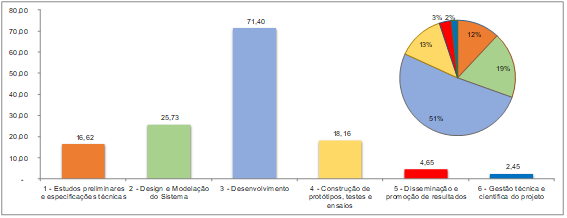
Between February and September 2025, the DABB – Driver Alert Black Box project progressed consistently and in line with the initial plan, reaching 82% of the planned execution for this period. Although some deviations occurred, they do not compromise the overall schedule compliance and are already addressed through recovery measures.
During these first eight months, the fundamental activities of requirements gathering, state of the art, technical specifications and system architecture definition were completed, both at the global solution level and its main modules. The team also developed the first structuring elements of the application interface, base layouts and the solution architecture, consolidating the necessary technological base for the following phases.
SKETCHPIXEL maintained an execution very close to plan, with particularly relevant advances in the implementation of the data acquisition, communication and storage system, as well as in the initial consolidation of the dataset, which will be essential for AI model training. The Polytechnic Institute of Tomar experienced some delays due to the holiday period and scholarship recruitment, but these constraints were overcome at the beginning of October, with a recovery plan already defined until March 2026.
The deliverables planned for this period were also completed, including the State of the Art Report, the Functional Specification Document, the System Architecture Document, the Acquisition and Storage System Specification, the first interface prototypes, the project's visual identity, the official website and the semi-annual technical-financial report.
Overall, the project is technically solid, with well-established scientific and technological foundations and all conditions in place to advance to the development phases of analysis models, pre-processing and risk behaviour classification. The recorded deviations are punctual and already addressed, representing no significant risk to the fulfilment of the operation's overall objectives.
The DABB project aims to develop an innovative system capable of recording, analysing and contextualising all variables associated with driving, regardless of the driver's actions.
The solution will enable the collection of essential data to understand the causes of accidents, identify risk behaviours and support entities such as insurers, manufacturers and public bodies in improving road safety.
This project represents a significant advancement in the area of intelligent mobility, combining computer vision technologies, machine learning and contextual event analysis.
1. Develop an advanced system for recording and analysing driving data, capable of contextualising events and identifying risk factors.
2. Create classification models for dangerous behaviours, based on real data and environmental variables.
3. Support insurers and public entities in risk assessment and accident prevention.
4. Implement real-time alert mechanisms for drivers and passengers.
5. Promote applied research in partnership with the Polytechnic Institute of Tomar.
Development of 4 new innovations in products, processes or services (official target: 4)
Creation of 3 qualified jobs in R&D activities (official target: 3 FTE)
Completion of 100% of planned activities (official target: 100%)
Consolidation of SKETCHPIXEL as an innovative company in the technology and intelligent mobility sector
Reduction of road accidents
Improvement of risk assessment in the insurance sector
Development of national technology with export potential
Strengthening of applied research in Portugal
Creation of qualified employment

The investment will evolve as planned in the application, adjusted to the start of investment (December 2020). The expected evolution will follow the planned schedule shown in the chart below

OE1: Development of 3D-related technology.
OE2: Development of AI models capable of feeding environment simulations with additional data, providing additional insights related to the accident timeline.
OE3: Vehicles are equipped with various sensors that allow data recording related to the operation of various active and passive safety systems. The forecast is that from 2022, vehicles will record data up to 30 seconds before the accident (Event Data Recorder - EDR). Regarding the perspective of information recorded by the vehicle and relevant for accident reconstruction, a procedure for collecting and processing vehicle data and its inclusion in kinematic models for accident chronology reconstruction will be developed.
OE4: Development of kinematic and dynamic models to perform the reconstruction of the moment of collision and the paths before and after impact.
OE5: Provide business growth and the exploration of business opportunities at the level of the business promoter in a market with high growth potential, leading to an increase in sales and operating margins, in terms of ROI, turnover and employees (job creation) within 4 years, fully leveraged by R&D investment.

OE1 | Development of Mixed Reality technology for hand movement interpretation enabling optimization of human-machine interaction in VR systems
OE2 | Development of sensor networks and LiDAR technologies for monitoring real parameters of a racing car and its surrounding environment, namely weight, acceleration, temperature, humidity, inclination, rotation and georeferencing;
OE3 | Development of predictive mathematical models capable of supporting the rapid development of real environment simulations, facilitating environment rendering and transmitting them to the user with a short delay;
OE4 | Development of a CPS on a Cloud platform capable of aggregating generic IoT data acquisition and combining it with programming/actuation interfaces.
OE5 | Creation of a structure for IoT and communications: Firmware Update Over The Air and secure wireless data transmission using technologies such as BLE, Wi-Fi, LoRa and NB-IoT;
OE6 | Expand the business of enterprise promoters into a market area with high potential and grow business activity, in turnover and workers within 4 years leveraged by R&D investment;
The potential of immersive reality systems and their vast field of application is well recognized. Despite the numerous systems available, there are currently no solutions that map static and dynamic obstacles in physical space, requiring users to move around in empty rooms or interact with the immersive system in a very limited space. On the other hand, user tracking relies only on the user's head (or hands, through controllers), or when additional tracking of limbs and hands is done, the user must be in a limited frontal space to RGB-D sensors or others. Full-body motion tracking in larger areas is normally solved using optical modulation or radio frequency identifiers placed at various points on the body and at the cost of high-frequency sensors for capturing these identifiers, making systems inflexible and extremely expensive.
This project proposes the development of a low-cost system, based on several RGB-D sensors (>=4), which simultaneously provides full tracking of the user at any point in space in large areas (tens of m2), in unstructured and dynamic environments, with gesture recognition for more natural interaction with the immersive environment, as well as interaction with the real world from the immersive world.
This application will allow use in various areas, from commercial (real estate promotion, showing future finishes/decoration in spaces), education (simulation of spaces in classrooms, museums, showrooms), training in simulation (accident situation simulation, police training, social training). The potential to adapt any space to a new virtual, dynamic world in which the user can move opens a whole new range of solutions with potential to be explored in various areas of activity.
The investments planned in this Project aim to objectively internationalize the company's services. To this end, the company intends to participate in international fairs specifically dedicated to digital commerce and WEB services.
Another way to promote the company's services and products to these clients/partners is through prospecting trips and direct presentations to attract new clients. In this type of products, the commercial effort is enormous as presentations and approaches extend over time, hence the need to hire a salesperson specifically dedicated to this international role.
This new phase of the company's life cycle requires the introduction of new and innovative management and commercial practices at the company level. This will be done by incorporating best market practices, management information systems (SIGE and respective hardware) as well as communication plans.
Regarding internal organization (competitiveness and productivity) and commercial practices, the company opts to equip itself with conditions so that its activity does not have limiting steps or process redundancies. To this end, investment in various management platforms and IT systems properly interoperable is a constant in this investment plan.

